


INSIDE THE OJOO VIOLENCE (I): EYEWITNESSES RECOUNT HOW THE CRISIS BEGAN
- psychlensui
- Jul 8
- 3 min read
By Faith Ajewole
Panic spread across the Ojoo axis of Ibadan on Wednesday after a violent disturbance involving Yoruba traders and Hausa scrap collectors, turned one of the city's busiest commercial corridors into a scene of chaos, forcing businesses to shut down and commuters to abandon their journeys.
The violence, which occurred along the Iwo Road–Ojoo Expressway in Akinyele Local Government Area of Oyo State, left two people dead, others injured, and halted commercial activities as residents fled for safety while motorists were trapped in heavy traffic.
Located about five kilometres from the University of Ibadan, Ojoo serves as a major commercial gateway into the city and remains a familiar destination for many students who visit the area to purchase affordable goods, board interstate vehicles, or commute within Ibadan.
Although security operatives have since restored calm to the area, authorities continue to investigate the circumstances surrounding the violence while appealing to residents to remain peaceful and avoid reprisals.
How the Violence Began
According to an eyewitness account, the crisis began on Tuesday night at about 11 p.m. following a disagreement between a Yoruba commercial tricycle (Maruwa) operator, who also worked as a mechanic, and a Point of Sale (POS) operator over a cash withdrawal transaction.
The eyewitness, alleged that a network failure delayed confirmation of the transaction after the rider had already received the cash, resulting in an argument between both parties.
According to the eyewitness, the rider left his tricycle, its keys and his mobile phone as collateral while the issue was being resolved. He, however, alleged that another individual later intervened in the dispute and attacked the rider.
He further alleged that the assailants brought out weapons, including a gun concealed inside a sack of collected scrap, chased bystanders and repeatedly stabbed the rider, who later died from the injuries sustained.
Recounting the incident, the eyewitness, said:
"What happened in Ojoo started since yesterday night at about 11 p.m. A Maruwa (tricycle) operator went to withdraw money from a POS. However, they said the money had not reflected, but they claimed they had already given the money to him. Meanwhile, the Maruwa operator gave the POS vendor his tricycle key together with his phone so that they would know he could not run away. But in less than five minutes, they rushed to the place. They started attacking the young man, stabbing him repeatedly until he died. The young man has been dead since last night. The trouble started from last night and escalated."
He further alleged that the violence intensified on Wednesday morning when residents gathered to seek an explanation over the incident.
"This morning, before we arrived here from Central and Cabling, when we got here, the boys picked up guns and started shooting at us. A little boy who had gone to buy Indomie was hit by a bullet, and the child is now dead. Right now, the whole area is under gunfire. Bullets are flying everywhere. This is not a joke; bullets are everywhere. If it hadn't been for God's protection, wouldn't I have died this morning? They even fired at me. They wanted to shoot me. Imagine. The police officers were there, but they just stood by watching with their arms folded. They didn't do anything to protect us."
His account further alleged that several persons were injured during the disturbance. He also claimed gunshots were heard during the violence, although security agencies had yet to officially confirm that aspect of the account.
Community Tension
By Wednesday morning, news of the rider's death had spread across the community, provoking outrage among local youths.
The tension escalated into retaliatory confrontations as angry youths reportedly set properties ablaze and confronted members of the Hausa community.
The unrest forced traders to hurriedly close their shops while traffic along the busy Iwo Road–Ojoo Expressway ground to a halt, leaving cars and trailers stranded for hours. Reports also indicated that many northern residents sought shelter over fears of possible reprisals.
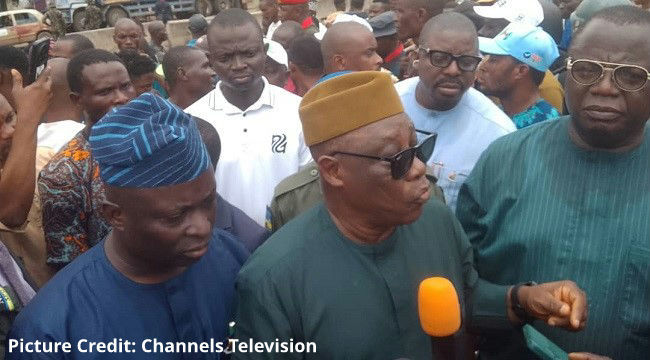
During the government's visit to the community, some Yoruba traders and community representatives appealed for the immediate evacuation of Hausa scrap collectors from the area, saying they no longer felt safe and feared further attacks at night.
There were also reports that a scavengers’ depot known locally as “Bolla” was set ablaze during the unrest.
However, the circumstances surrounding the fire and those responsible for it had not been independently verified at the time of this report.
Despite the tension, community leaders continued to advocate dialogue as the path to restoring peace.
Other Sources:
Punch E-Paper
Channels Television
The Guardian Nigeria News
Newspeak Online
The Sahara Reporters
The Tribune


Comments