


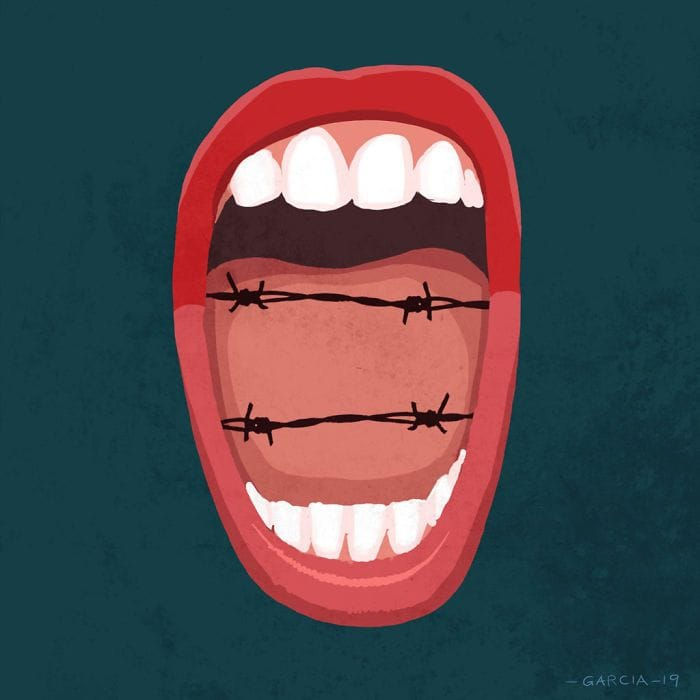
THE SOUND YOU THINK YOU HEAR
By Simchia
It's common for people to believe they can spot a lisp. You've probably seen them in cartoons, and heard them in jokes, and while listening to someone you've deemed incompetent even before they finish talking.
A lisp is classified as a speech sound disorder. It is a result of faulty patterns of speech. The faulty articulation of sibilants like /s/ and /z/ can be caused by incorrect positioning of the tongue (too far forward or high) or by airflow being released from the sides of the tongue.
There are different kinds of lisps, and speech pathologists have identified four types: interdental, lateral, palatal and dentalized. In each case, people hear speech that sounds wrong before they hear any other sounds that inform them of anything else.
Me, too. I have one. Most of my friends and family don't know this. I have learned how to position my tongue correctly, slow down when I speak at important times, and choose words that won't call attention to my lisp. I've practiced speaking by watching myself in mirrors, alone, and as I pause between contractions to think about what word could give me away. This process takes a lot of energy and is undesired but necessary to keep my condition a secret. It is serious work and the effort isn't always visible, which is exactly the goal I try to achieve.
Speech sound disorders are found in 8-9% of children aged 0-9 years. After age 9, 1-2% will remain lisped or distort sounds throughout their lifetime. In 2007, a pilot study done by Ghent University revealed that 23.3% of 748 native adult Dutch speakers enrolled in an institution of post secondary education had a lisp. This is equal to about 1 out of every 4 adults.
Treatment works. A randomized controlled trial conducted in 2021 showed that lisping improved significantly with an average of 28 sessions (with the lowest number being 15 to reach statistically significant improvement) in 30 people receiving treatment. A 2013 study of preschool-aged children receiving three treatment sessions/week versus one session/week demonstrated that the former group had significantly greater improvement than the latter group at 24 sessions of treatment. Frequency matters. Dose matters.
Interestingly, a study conducted by Syrett and Brorson in 2005 demonstrated that when participants watched two different videos of women (one speaker with a frontal lisp and the other without), the lisping speaker was evaluated to be uncooperative, unkind, unfriendly, and unpleasant compared to the speaker who did not have a lisp, according to 41 participants. In Silverman's 1976 study, a similar study conducted with the same methodology showed a bias towards men and women with lateral lisps as well. In both studies, participants did not know that they were being tested for their biases; they had strong, negative visceral reactions to the sounds of these lisping speakers and formed their opinions before they processed the information they were exposed to. Therefore, this is an issue of creating meaning in the world, as a lisp generally does not get in the way of being understood. However, having one prevents an individual from being taken seriously.
While I sit quietly through meetings, I think to myself, "What does this do to my ability to positively influence others?" I think about it when I don't speak to express my opinions, when I send an email rather than calling, or when I'm waiting for the perfect moment to say something. Research calls this stigma consciousness but my lived experience calls it Thursday.
A lot of famous people have a lisp and have been able to succeed despite it. For example, Barbara Walters was given speech therapy when she started at NBC, but when she stopped having the therapy, she felt more self-confident with her lisp because she accepted it. Michael Phelps has said he would drop Ls and insert Ss into words when he spoke quickly, and generally when he was trying to prove he did not have a lisp, he would lisp the word. Grimes tweeted that many journalists ask her why she sings with a lisp. Her response? "I. have. a. speech. impediment. & I can't do anything about it so let it be."
Impediment is from the Latin word impedimentum meaning hindrance. However, the estimated 1-2% of the general population (i.e. the number of adults with residual sibilant distortions) are not defective. They are just a statistically predictable minority. The speech disorder is not the impediment; the real impediment is the expectation that we should all speak the same way.
It is true that the sooner a child is engaged with speech therapy, the more successful their outcomes will be. But when children continue to experience difficulty communicating at the age where they should have outgrown those challenges, we are looking at multiple reasons. These children tend to be boys, come from disadvantaged socioeconomic backgrounds, and may have a history of hearing loss. These children deserve access to therapy, but they also do not deserve to be treated like broken people, even while waiting to go to their first appointment or start their therapy sessions.
The fact of the matter is that the social cost of having a lisp is simply a socially-defined concept. The 2005 study on how listeners view people that have a lisp only measured how the listeners thought or perceived the speakers. There were no measurements taken regarding the kindness, supportiveness, or any other qualities of the participants. To put it another way, people equate the sound of the lisp to a person being childish/immature/weak, and they treat them as such. Ultimately, that is a learned behavioral response, and it can easily be unlearned.
I've kept my lisp a secret for many years. For example, I would build my sentences like an architect constructs a building, so that I wouldn't have to say a "bad" (or lisped) sound on the last word of a statement that required that sound. I've been in meetings where I wasn't able to speak up, and as a result, I let someone else take credit for my idea. I've had many people judge me as being less intelligent, less competent than I really am, as a result of a tiny fraction of a second of sound, which had no connection to my knowledge.
The tongue is a muscle. So is bias. Both can be trained. One is trained through speech therapy; the other is trained through paying attention. Both require practice. Both require you to decide that the status quo isn't good enough.
I'm so tired of hiding. And I'm tired of being told that my exhaustion is because of a defect in my character, rather than simply being a logical reaction to an oppressive, social environment. The research is available; the numbers are there. There simply hasn't been enough acceptance of these realities and the willingness to change our behaviour as a collective.
Tho thith ith how I thound. Thith ith how millionth of other adulth thound. There'th a dithtorthion with the thibilant thound but you can eathily figure out what it ith trying to convey. I've thtudied hard tho my level of performanthe ith no ithue to judge by anyone elthe.


Comments